Best Free ISBN Scanner Tools in 2026 — Compared
I tested five ISBN scanner tools with the same stack of books to see which returned the most complete data, fastest — and which are actually worth using for a real cataloging session. For casual users and collectors, ISBNFetch came out on top: it works in any browser, requires no app download, and returns full book data in under 3 seconds. For developers needing bulk API access, ISBNdb is the stronger choice despite its subscription cost. Here is how each tool compares.
Quick comparison table
All pricing as of March 2026.
| Tool | Free tier | Paid | Camera scan | Best for |
|---|---|---|---|---|
| ISBNFetch | 50 scans | From $5.99 | Yes (browser) | Collectors, resellers |
| ISBNdb | Limited trial | $14.95+/month | No | Developers, bulk API |
| LibraryThing | Unlimited (free) | Free | App only | Community, social |
| CLZ Books | 7-day trial | $1.99/mo (mobile) | Yes (app) | Collectors (app-first) |
| Open Library | Free API | Free | No | Developers, borrowing |
1. ISBNFetch — best for individuals and collectors
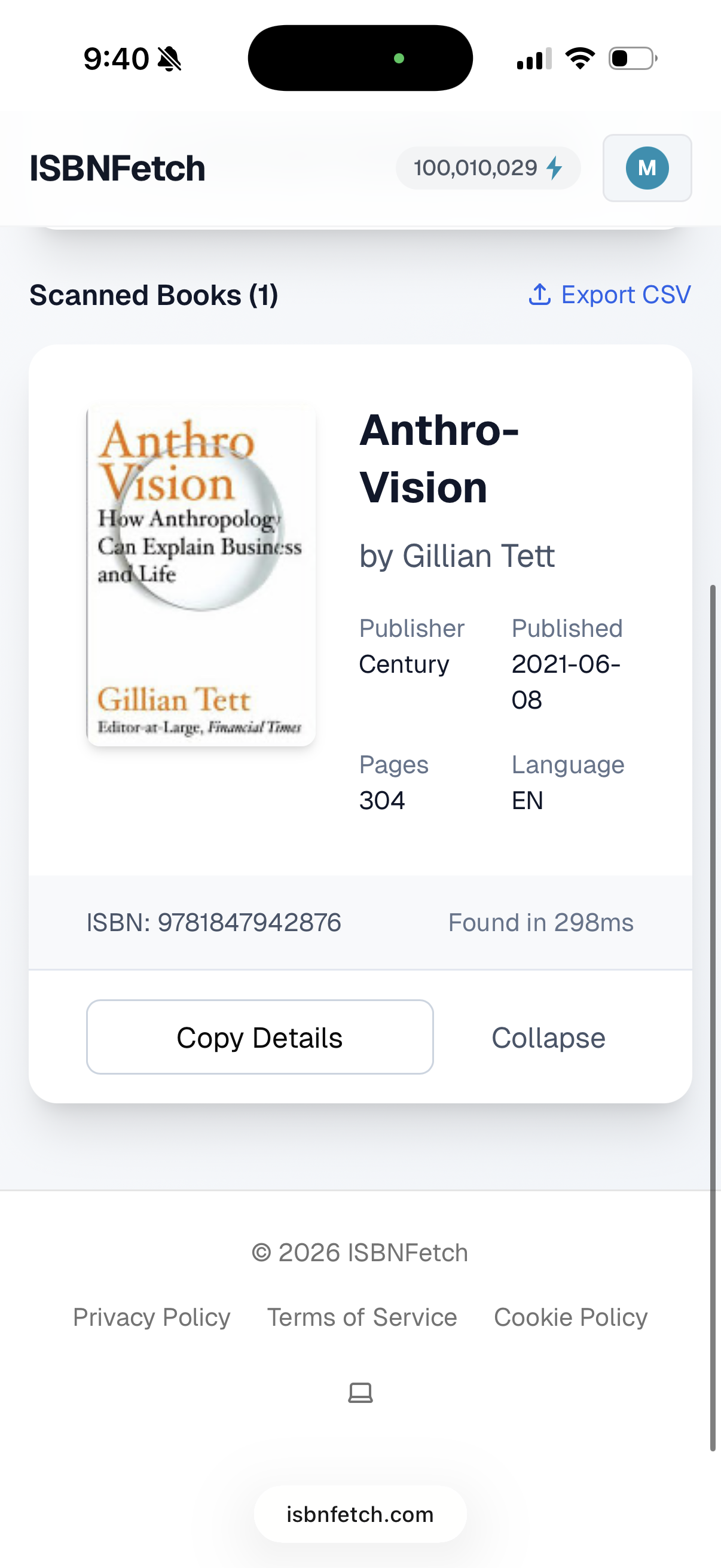
ISBNFetch is a web-based ISBN scanner that works entirely in your browser. You do not need to install an app. Point your phone or webcam camera at a barcode and the book record appears in under 3 seconds: title, authors, publisher, publication date, page count, language, description, and cover image.
The pricing model is pay-as-you-go rather than a monthly subscription. You can try 3 scans with no account at all, and every new account gets 20 free scan credits. When you need more, you buy a block of credits starting at $5.99 for 100 scans — valid for 12 months. This makes it a good fit for people who scan intensively for a weekend project (cataloging a home library, pricing books at an estate sale) but do not need the tool every month.
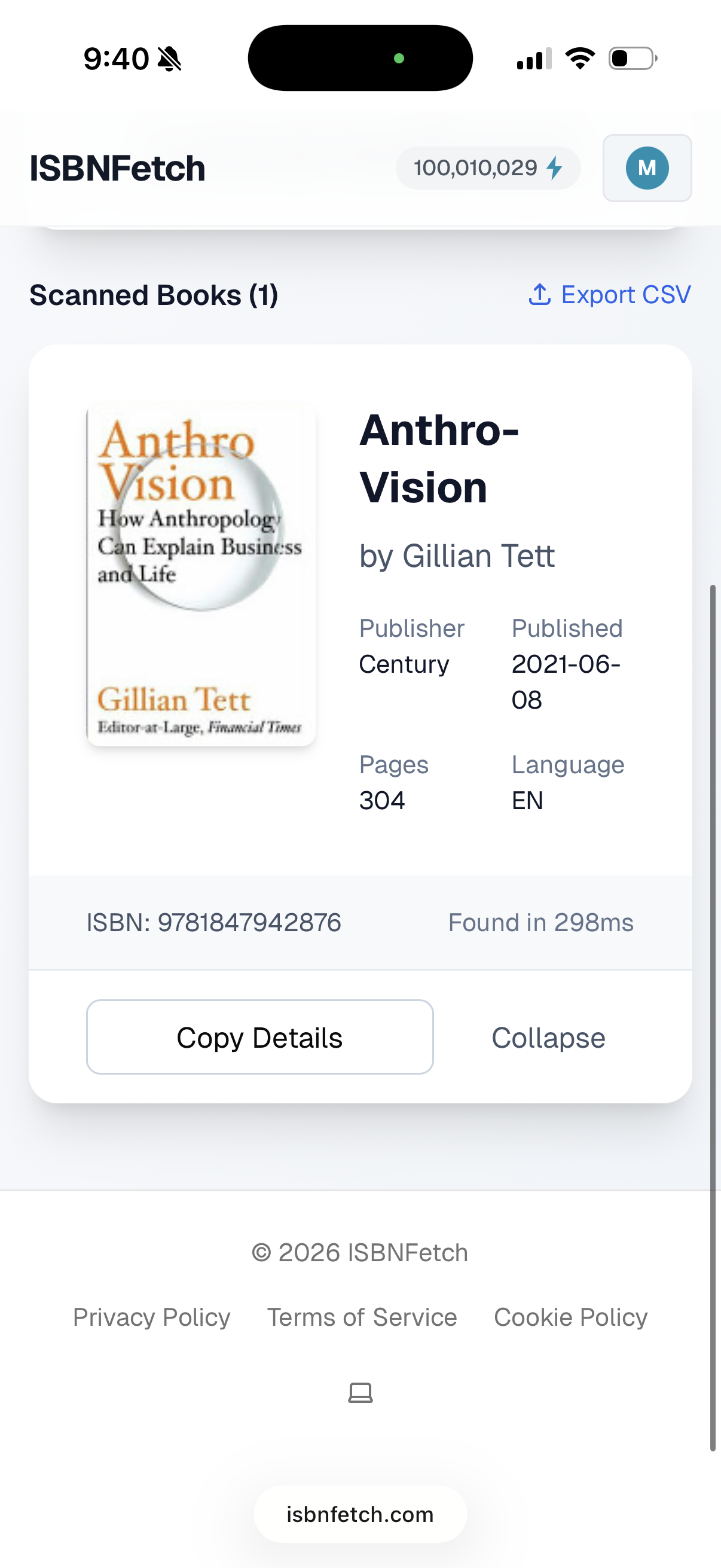
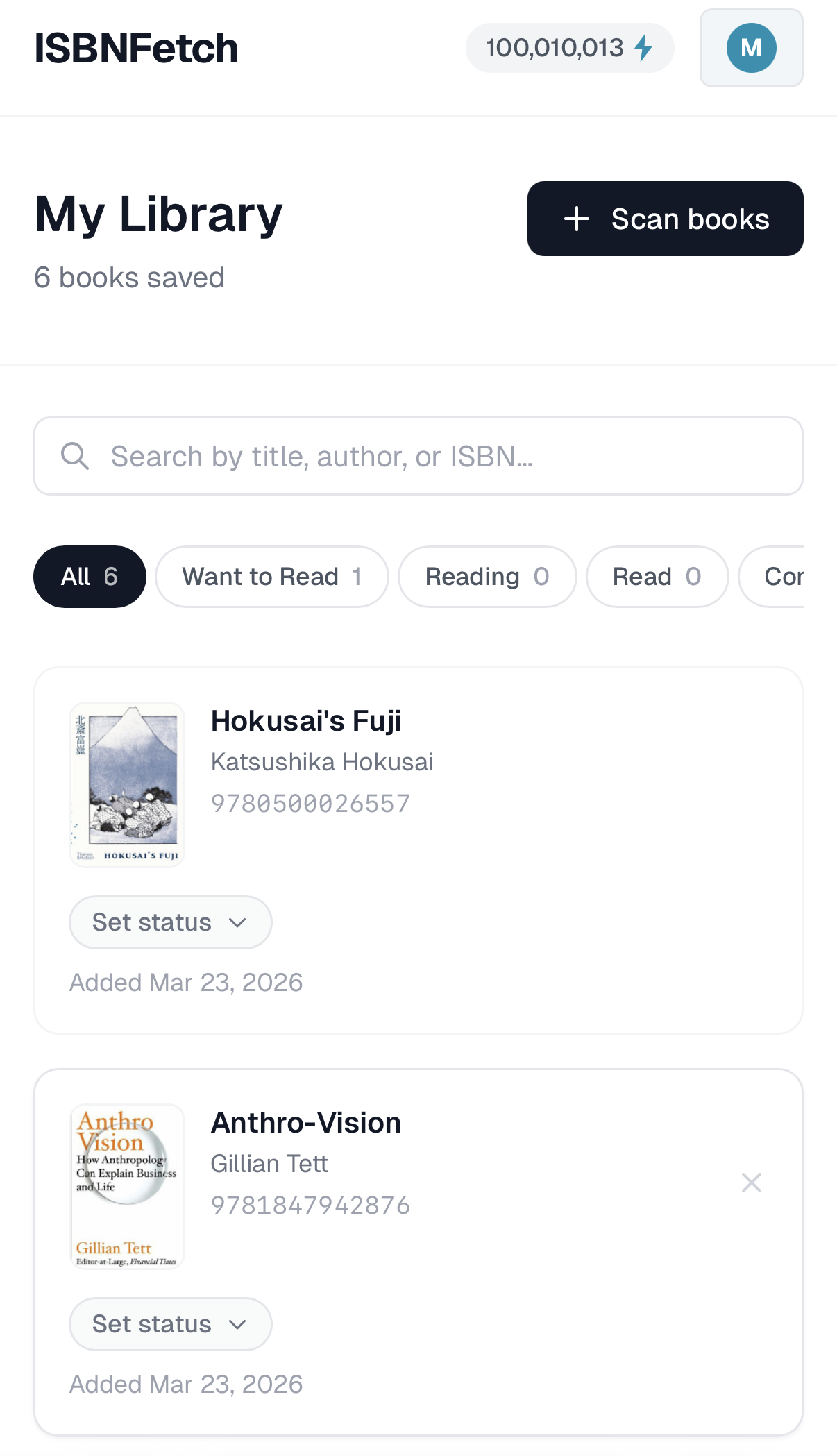
Every scanned book is saved to a personal library. You can filter by reading status (Want to Read, Reading, Read, Completed), search by title or author, and export your full collection to CSV or JSON with one click. The CSV opens directly in Excel, Google Sheets, or Numbers.
ISBNFetch at a glance
- Camera scanner: Yes — browser-based, no app required
- Manual entry: Yes — ISBN-10 and ISBN-13
- Batch lookup: Yes — upload a file with multiple ISBNs
- Library tracking: Yes — with reading status
- Export: CSV, JSON
- Free tier: 50 scans
- Paid: $5.99 for 100 scans · $12.99 for 300 · $29.99 for 1,000
- Best for: Personal collectors, used book resellers, students
2. ISBNdb — best for developers and bulk API users
ISBNdb is an API-first book database with a catalog of over 33 million books. It is designed for developers who need to query ISBNs at volume from their own applications. There is no consumer interface — you get a JSON API, not a scanner you can point at a book.
Plans start at $14.95 per month. For a developer building a book cataloging app or needing to look up thousands of ISBNs per day, ISBNdb's depth and reliability justify the cost. For a personal collector wanting to scan their home library on a Saturday afternoon, the subscription friction and API setup make it the wrong tool.
ISBNdb is the strongest tool in its category — but its category is developer tooling, not consumer ISBN scanning.
3. LibraryThing — best for community and social cataloging
LibraryThing has been around since 2005 and has one of the largest book-cataloging communities online. You can catalog your books, write reviews, join reading groups, and discover what other members with similar libraries are reading.
LibraryThing is now completely free with no book limit. It previously charged $10/year or $25 for a lifetime membership, but removed all pricing in March 2020. The mobile app supports camera scanning.
The downside is that the interface feels dated, especially on mobile. If community and social features matter to you, LibraryThing is worth considering. If you just want to catalog your library and export the data, it adds more friction than necessary.
4. CLZ Books — best dedicated book collection app
CLZ Books is a polished mobile-first app for cataloging books. It has strong camera scanning, good metadata coverage, and a clean library interface. The app is available on iOS and Android.
The catch is a subscription model: the mobile app costs $1.99 per month or $19.99 per year after a 7-day free trial. The web version is $3.95/month. For someone who scans hundreds of books once a year to catalog a new acquisition, an annual fee for an occasional task adds up. CLZ makes more sense for active collectors who use it regularly.
CLZ also makes apps for other media (movies, games, comics), so if you collect across categories it has ecosystem advantages. Book-only users may find the cost hard to justify compared to free or pay-per-use alternatives.
5. Open Library — best free database and borrowing resource
Open Library, run by the Internet Archive, is a free book database and digital lending library. Its ISBN API is free and open to use — you can query any ISBN and get back metadata.
There is no consumer scanner interface. You cannot point a camera at a barcode and get a result. Using Open Library for ISBN scanning requires you to build or use a separate barcode scanner and then query the API yourself.
Open Library is most useful as a data source for developers, or for borrowing digital books through its lending program. It is not a practical option for someone who wants to scan and catalog a physical book collection without writing code.
Which ISBN scanner tool should you use?
The right tool depends on what you are trying to do:
- You want to catalog your home library or scan books at a thrift store: Use ISBNFetch. Works in your browser, 3 free scans to start (no account), no subscription.
- You are building an application that needs bulk ISBN lookups: Use ISBNdb. Its API is the most comprehensive option for programmatic access.
- You want to join a community of book lovers and share reviews: Use LibraryThing. It has the largest book-cataloging social community.
- You collect across media (books, movies, games) and want one app: Use CLZ. Its ecosystem handles multiple collection types.
- You need a free database or want to borrow digital books: Use Open Library. Its API is free and its lending catalog is extensive.
For most individuals — collectors, students, used book sellers, or anyone who has ever wanted to know what books are on their shelves — ISBNFetch is the lowest-friction option. No app download, no monthly commitment. Scan a barcode, get the data, export when done.