What Is an ISBN Number? A Complete Guide
An ISBN (International Standard Book Number) is a unique numeric identifier assigned to every published book. It is the barcode on the back cover of a book — a 13-digit number (or 10-digit for books published before 2007) that identifies the exact edition and format of that title. Type or scan an ISBN into any book database and you get back the complete bibliographic record for that specific book.
What ISBN stands for
ISBN stands for International Standard Book Number. It is a commercial numbering system designed to standardize the identification of books worldwide. Every published book — whether a paperback, hardcover, e-book, or audiobook — is assigned its own unique ISBN.
The system was created in the UK in 1966 by bookseller W.H. Smith, originally as a 9-digit Standard Book Number. It was adopted internationally as the ISBN standard in 1970 and expanded to 10 digits, then transitioned to 13 digits in January 2007 to increase the available number pool and align with the EAN barcode system used in retail.
ISBNs are managed by the International ISBN Agency, which delegates national ISBN registration to agencies in each country. In the United States, ISBNs are assigned by Bowker. Publishers purchase blocks of ISBNs to assign to their titles.
How to read an ISBN
A modern ISBN-13 has five parts, separated by hyphens when printed (though the hyphens are not part of the number itself):
978-0-306-40615-7
- 978 — EAN prefix (all books use 978 or 979)
- 0 — Registration group (country or language area; 0 and 1 = English-speaking)
- 306 — Registrant (the publisher)
- 40615 — Publication (the specific title and edition)
- 7 — Check digit (calculated from the other digits to catch errors)
The registration group identifies the country or language area. Group 0 and 1 are for English-language books. Group 2 is for French. Group 3 is for German. Group 7 is for Chinese. Groups are allocated by the International ISBN Agency to national agencies.
The check digit is the last number in the ISBN. It is calculated from the preceding digits using a weighted sum algorithm. Scanners and lookup tools use the check digit to verify that the number was scanned or typed correctly — if the check digit does not match the calculation, the ISBN is invalid.
ISBN-10 vs ISBN-13
Before January 1, 2007, books used a 10-digit ISBN. From that date forward, all new ISBNs are issued in the 13-digit format.
| Format | Digits | Used from | Example |
|---|---|---|---|
| ISBN-10 | 10 | 1970–2006 | 0-306-40615-2 |
| ISBN-13 | 13 | 2007–present | 978-0-306-40615-7 |
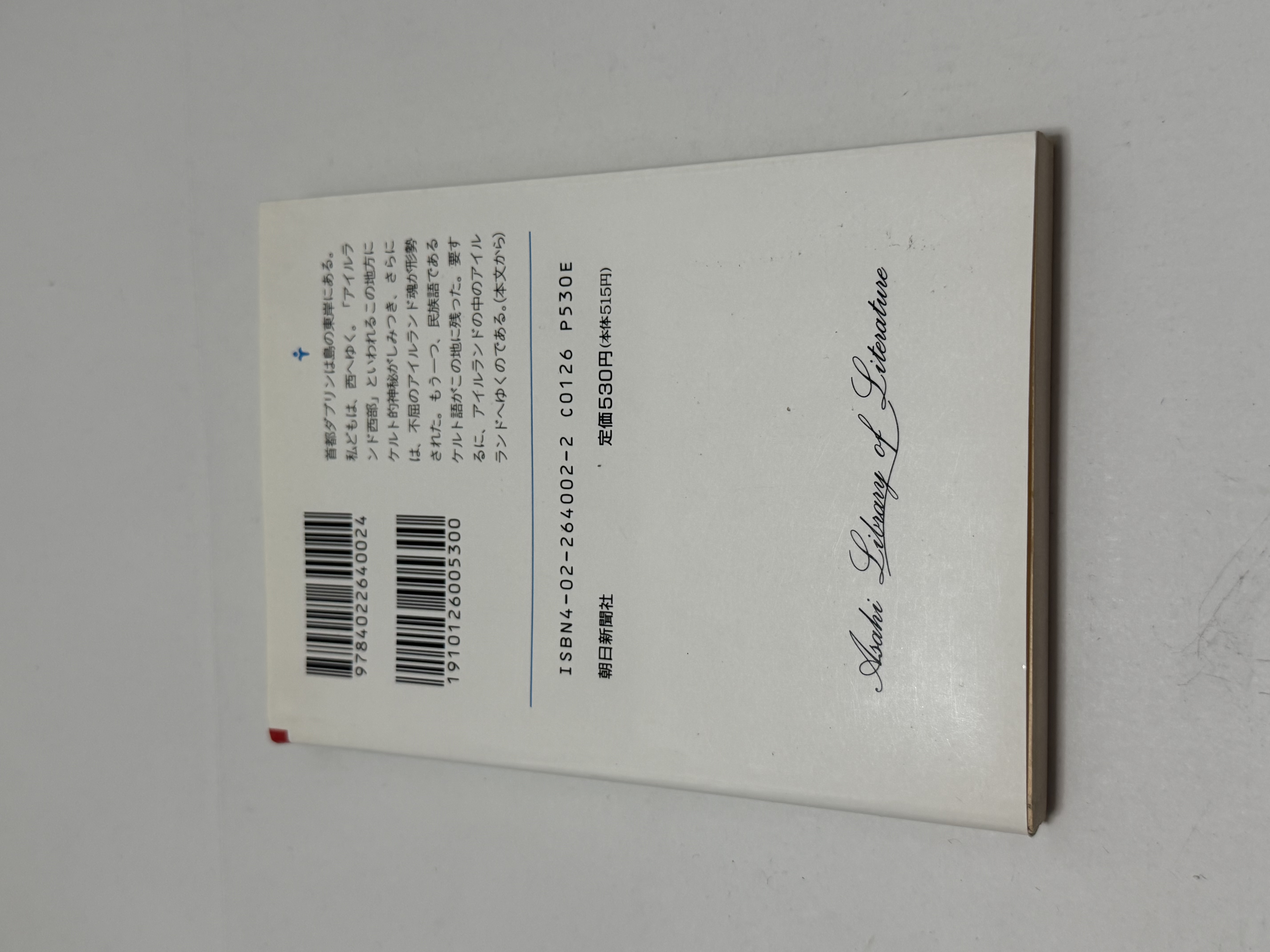
ISBN4-02-264002-2 (ISBN-10).Any ISBN-10 can be converted to its ISBN-13 equivalent by adding the prefix 978 and recalculating the check digit. The two formats refer to the same book — they are interchangeable identifiers for the same edition.
If you have an older book with a 10-digit ISBN and type it into a lookup tool like ISBNFetch, it will be accepted and matched automatically. Most databases accept both formats.
Where to find a book's ISBN
There are several places the ISBN appears on a physical book:
- Back cover barcode: The EAN-13 barcode printed on the back cover of most books is the ISBN-13, encoded as a scannable barcode. This is what a camera scanner reads.
- Copyright page: The copyright page (usually the reverse of the title page) prints the ISBN in text form, often with separate ISBN-10 and ISBN-13 numbers for older books.
- Spine: Some books print the ISBN on the spine near the bottom, though this is less common.
- Publisher's website or catalog: If the book is available for sale online, the product page will list the ISBN.
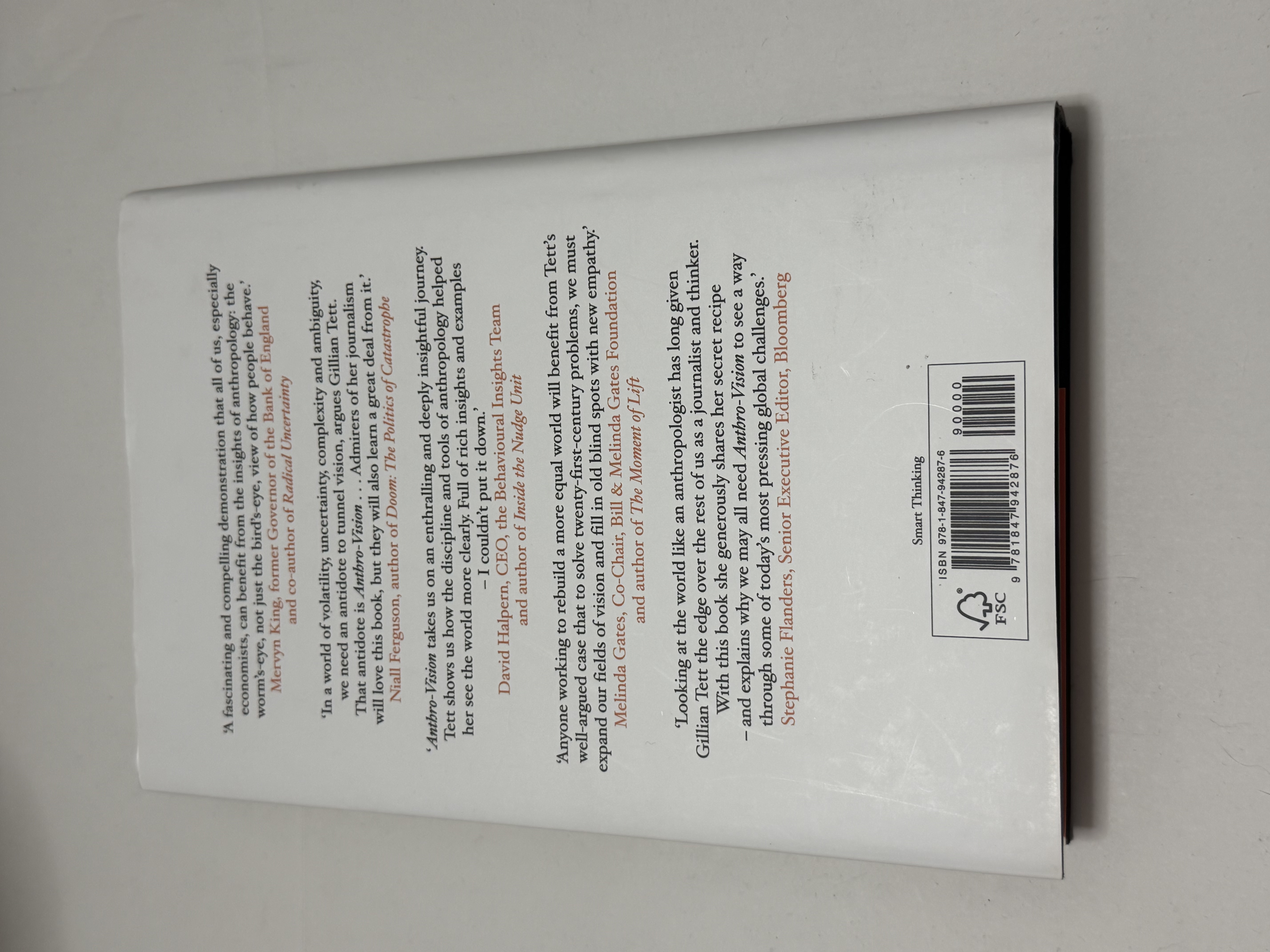
Books published before 1970 do not have ISBNs — the system did not exist yet. Books from the 1970s and 1980s may have 10-digit ISBNs that were assigned retrospectively, but coverage is incomplete for that era. Very rare or self-published books may also lack an ISBN if the publisher did not purchase one.
Why ISBNs matter
ISBNs solve a deceptively hard problem: books have no other globally unique identifier. Titles are not unique — there are many books called "The Great Gatsby." Author names vary by edition and translation. Publishers change names and imprints.
The ISBN is specific to the exact edition and format of a book. A hardcover first edition, a paperback reprint, and a large-print edition of the same title each have different ISBNs. An e-book and a physical copy have different ISBNs. This precision matters for:
- Booksellers and retailers — ordering and stocking the right edition
- Libraries — cataloging and linking to the correct record
- Used book resellers — identifying whether a copy is a valuable first edition or a common reprint
- Personal collectors — tracking exactly which version of a book they own
- Students — confirming they have the correct textbook edition required by a course
For anyone managing a book collection — personal library, resale inventory, or institutional catalog — the ISBN is the most reliable way to identify what you have.
How to look up a book by ISBN
To look up a book by ISBN, you need a tool that queries one or more book databases. The lookup returns the bibliographic record for that exact edition: title, authors, publisher, publication date, page count, language, and description.
ISBNFetch lets you look up any ISBN three ways:
- Camera scan: Open ISBNFetch in your browser and point your phone or webcam camera at the barcode on the back cover. The ISBN is decoded and the book record returned in under 3 seconds.
- Manual entry: Type or paste the 10- or 13-digit ISBN directly. Useful for older books without a scannable barcode.
- Batch upload: Upload a plain text file with one ISBN per line. Returns results for all books at once, which can be exported to CSV.
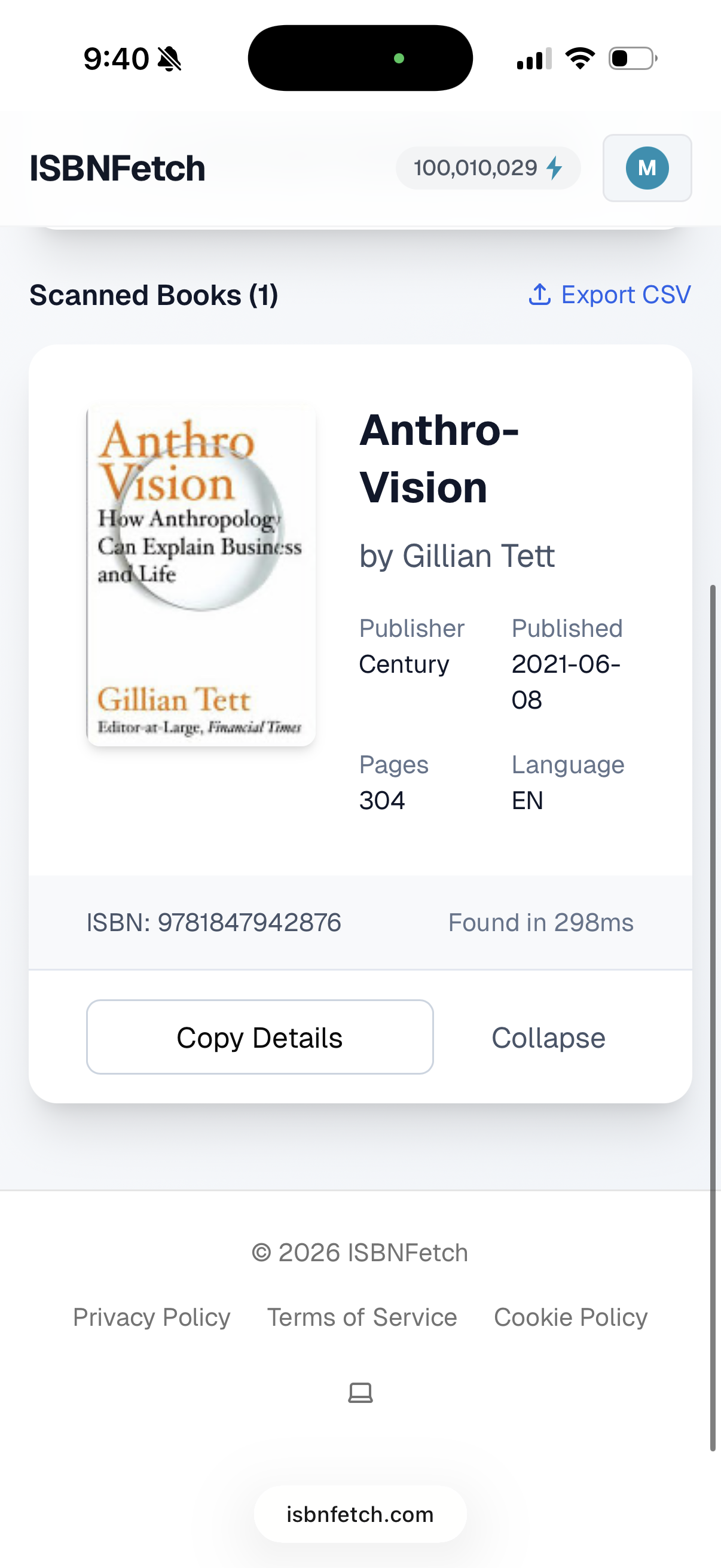
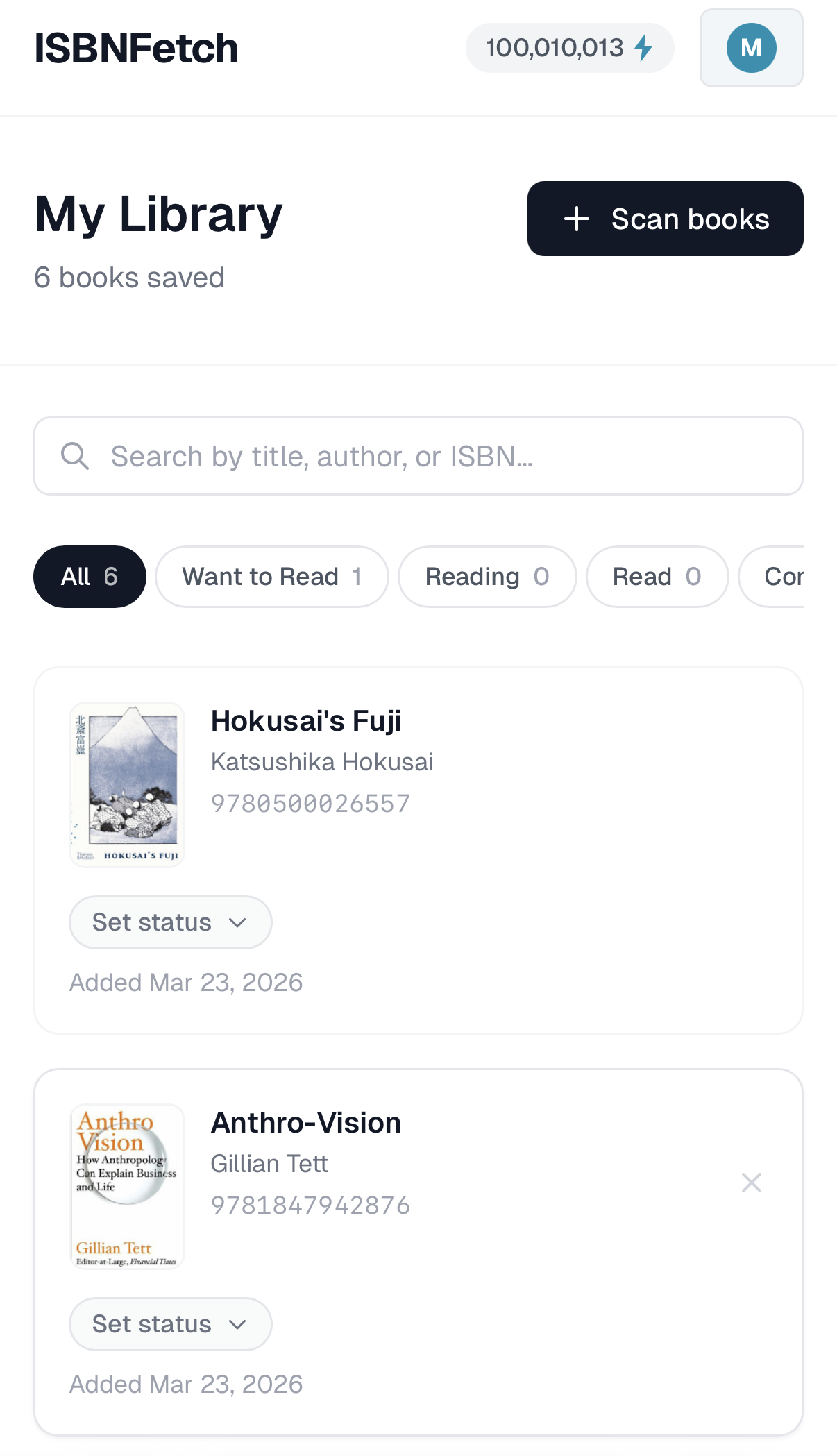
Once you look up a book, you can save it to your personal library with one tap. Your library tracks reading status, lets you search and filter, and exports to CSV or JSON for use in spreadsheets, Notion, or Airtable.
ISBNFetch is free to start — new accounts receive 50 scan credits with no credit card required.
Frequently asked questions
How many digits is an ISBN?
An ISBN has either 10 or 13 digits. Books published before January 2007 use ISBN-10. All books published from 2007 onward use ISBN-13. Both formats identify the same edition — most lookup tools accept either.
What does ISBN stand for?
ISBN stands for International Standard Book Number. It is a unique numeric identifier assigned to every published book, audiobook, and e-book to distinguish one edition and format from all others.
Where is the ISBN located on a book?
The ISBN appears as a barcode on the back cover, printed in text on the copyright page (the reverse of the title page), and sometimes on the spine near the bottom. The back cover barcode is the easiest to scan.
Can two books have the same ISBN?
No. Each ISBN is assigned to exactly one edition and format of a book. A hardcover and paperback edition of the same title have different ISBNs. An e-book and a physical copy have different ISBNs. This uniqueness is what makes ISBNs reliable for identifying a specific book.
Look up any ISBN now
3 free scans, no account needed. No credit card. Works in any browser.
Start scanning